
 English
 Chinese
 Hindi
Hindi Spanish
 Arabic
 French
 Bengali
 Portuguese
 Japanese
 German
 Swedish
 Korean
 Italian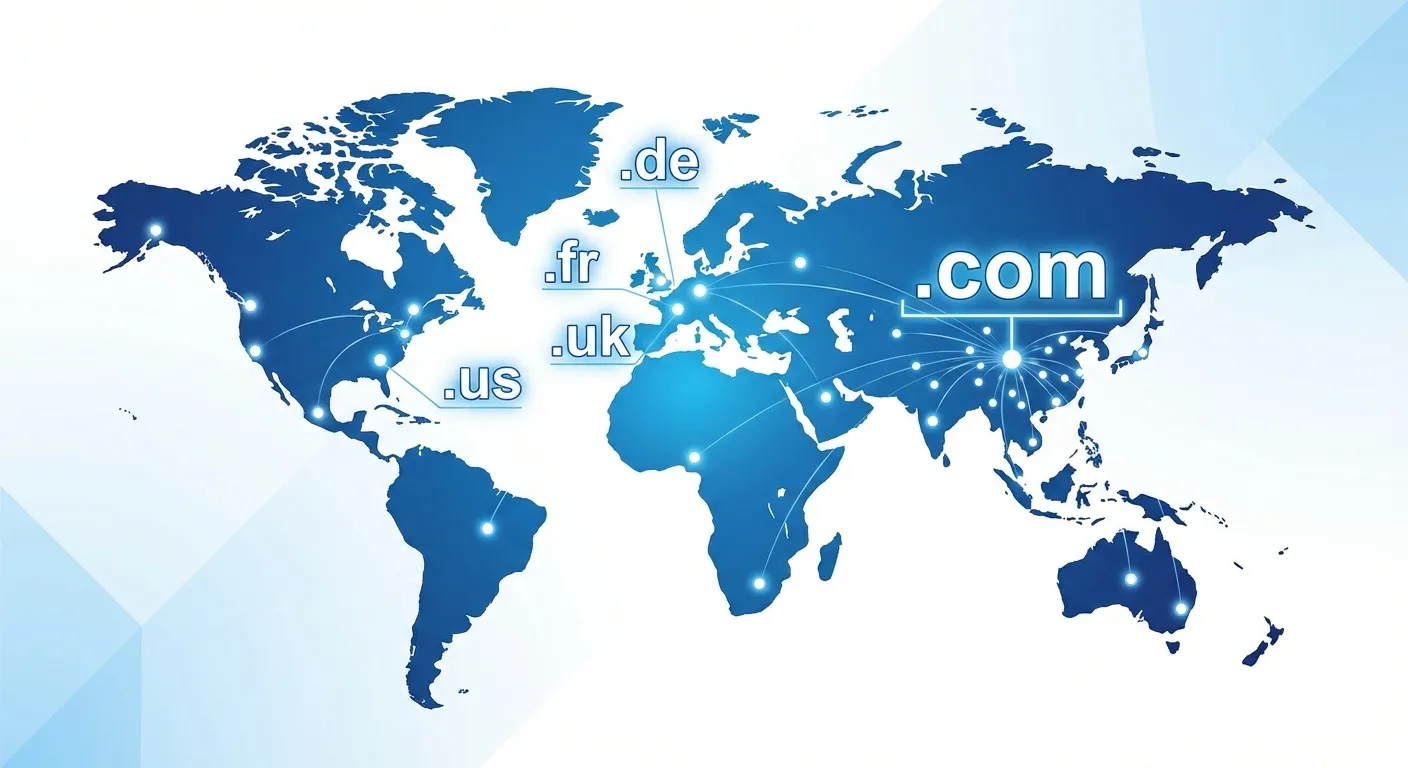
Understanding the Domain Decision That Shapes Your Global Success
When expanding your business internationally, one of the most important decisions you’ll make is your domain strategy. The choice between a ccTLD vs gTLD affects everything from how search engines rank your site to how potential customers perceive your brand in different markets.
This comprehensive guide breaks down the differences between country-code top-level domains (ccTLDs) and generic top-level domains (gTLDs), helping you make the right choice for your business goals. Whether you’re targeting a single new market or building a truly global presence, understanding these domain types is essential for success.
In this guide, you’ll discover:
- What ccTLDs and gTLDs are and how they function differently
- The SEO advantages and considerations of each domain type
- How domain choice impacts consumer trust and conversion rates
- When to choose a ccTLD, gTLD, or a combined strategy
- Real-world scenarios to help you decide what’s best for your business
What is a TLD? The Foundation of Domain Strategy
Before diving into the ccTLD vs gTLD comparison, let’s establish what a TLD actually is. A top-level domain (TLD) is the last segment of a domain name—the part that comes after the final dot. In “eurosalesman.com,” the TLD is “.com.”
TLDs are managed by the Internet Corporation for Assigned Names and Numbers (ICANN) and fall into several categories. The two most relevant for international business strategy are ccTLDs and gTLDs.
What is a ccTLD? Country-Code Top-Level Domains Explained
A ccTLD (country-code top-level domain) is a two-letter domain extension assigned to a specific country or territory. These domains are based on ISO 3166-1 alpha-2 country codes and are typically managed by organizations within each country.
Common ccTLD examples:
- .de — Germany
- .fr — France
- .uk — United Kingdom
- .se — Sweden
- .us — United States
- .jp — Japan
- .in — India
ccTLDs signal geographic relevance to both search engines and users. When someone sees a .de domain, they immediately understand the site is oriented toward the German market.

What is a gTLD? Generic Top-Level Domains Explained
A gTLD (generic top-level domain) is not tied to any specific country. These domains were originally intended for particular purposes or communities but are now available for general registration worldwide.
Common gTLD examples:
- .com — Commercial (most popular globally)
- .org — Organizations
- .net — Network services
- .info — Information
- .biz — Business
Since 2012, ICANN has also approved hundreds of new gTLDs like .shop, .tech, .online, and .global. While these offer branding opportunities, the classic gTLDs (especially .com) remain the most recognized and trusted worldwide.
ccTLD vs gTLD: Key Differences at a Glance
Understanding the core differences between gTLD vs ccTLD options helps you make an informed decision. Here’s a comprehensive comparison:
| Factor | ccTLD | gTLD |
|---|---|---|
| Geographic Signal | Strong — tied to specific country | Neutral — globally recognized |
| Local SEO Impact | Strong ranking boost in target country | Requires geo-targeting setup |
| Consumer Trust | High trust with local audiences | Broad recognition (.com) |
| Registration Requirements | Varies — some require local presence | Open to anyone worldwide |
| Best For | Targeting specific national markets | Global brand presence |
| Management Complexity | Multiple domains to manage | Single domain, simpler management |
ccTLD vs gTLD for SEO: Which Performs Better?
One of the most common questions in the ccTLD vs gTLD SEO debate is which domain type delivers better search engine rankings. The answer depends on your target market and strategy.
ccTLD SEO Advantages
Automatic geo-targeting: Search engines like Google automatically associate ccTLDs with their respective countries. A .de domain signals German relevance without additional configuration.
Local ranking boost: ccTLDs often receive preferential treatment in local search results. When a user in France searches for a product, sites with .fr domains have a natural advantage.
Clear market intent: ccTLDs send unmistakable signals about your target audience, helping search engines serve your content to the right users.
gTLD SEO Considerations
Domain authority consolidation: With a single gTLD, all backlinks and SEO efforts strengthen one domain rather than being distributed across multiple country-specific sites.
Flexible geo-targeting: Using Google Search Console, you can target gTLDs to specific countries, though this requires manual configuration.
Global reach potential: A .com domain can rank well internationally when combined with strong content and proper hreflang implementation.
For businesses serious about succeeding in specific national markets, ccTLDs typically deliver stronger local SEO results. For a deeper look at how ccTLDs enhance localization, see our guide on how ccTLDs help with localization.
Consumer Trust: How Domain Choice Impacts Credibility
Beyond SEO, the ccTLD vs gTLD decision significantly affects how consumers perceive your business.
The Psychology of Local Domains
When a German consumer sees a .de domain, they make instant assumptions: this company understands the German market, complies with local regulations, and is committed to serving German customers. These assumptions translate directly to higher click-through rates and increased trust.
Research consistently shows that consumers prefer to buy from websites that appear local. A ccTLD serves as a visual trust signal that immediately differentiates your business from foreign competitors.
The Global Recognition of .com
The .com gTLD benefits from decades of brand recognition. It’s universally understood as a commercial website and carries credibility through sheer familiarity. For businesses operating across many countries without deep local focus, .com provides a solid foundation of trust.

When to Choose a ccTLD vs gTLD: Decision Framework
Choosing between a ccTLD or gTLD depends on your business model, target markets, and growth strategy. Here’s when each option makes the most sense:
Choose ccTLDs When:
- You’re targeting specific national markets with dedicated resources
- Local SEO performance is critical to your business success
- Building trust with local consumers is a priority
- You want to establish a committed local presence
- Competitors in your target market use ccTLDs
Choose gTLDs When:
- Your business serves a global audience without specific country focus
- You prefer managing a single domain for simplicity
- Brand consistency across all markets is essential
- Your products or services transcend geographic boundaries
- You’re a startup with limited resources for multiple domains
Consider a Combined Strategy When:
- You want both global brand recognition and local market strength
- You’re expanding into multiple countries with serious growth intent
- You have resources to manage multiple domains effectively
- Your competitors use multiple domain strategies
Best Practices for International Domain Strategy
Whichever path you choose in the ccTLD vs gTLD decision, following these best practices ensures optimal results:
For ccTLD Strategies
Invest in localized content: A ccTLD alone isn’t enough. Combine it with properly localized content that resonates with local audiences.
Implement hreflang tags: Even with ccTLDs, proper hreflang implementation helps search engines understand the relationship between your different country sites.
Build local backlinks: Strengthen each ccTLD with backlinks from relevant local sources to maximize SEO impact.
For gTLD Strategies
Use subdirectories for languages: Structure your site as example.com/de/, example.com/fr/, etc., for clean organization and consolidated domain authority.
Configure geo-targeting: Use Google Search Console to specify target countries for each subdirectory.
Prioritize hreflang: With a gTLD, hreflang tags become even more critical for directing users to the right language/region version.
How Eurosalesman Delivers the Best of Both Worlds
For many businesses, managing multiple ccTLDs across dozens of countries would be overwhelming. That’s where Eurosalesman provides a powerful solution.
Eurosalesman operates verified national market domains across 70+ countries—including eurosalesman.de, eurosalesman.fr, eurosalesman.se, eurosalesman.us, and many more. When you advertise through our platform, your business gains the local credibility and SEO benefits of ccTLDs without the complexity of managing them yourself.
Each domain is protected by our WIPO-registered global trademark, giving you the confidence to expand into new markets with your brand identity secured.
Combined with AI-powered content creation and real-time analytics, you get a complete international growth platform that handles the domain strategy complexity for you.
Start Your International Domain Strategy Today
The ccTLD vs gTLD decision is just the beginning of your international growth journey. With the right strategy and the right platform, you can reach customers in markets around the world while building the local trust that drives conversions.
Ready to expand globally with ccTLD credibility? Post your first ad or explore our global markets to see how Eurosalesman makes international expansion simple and effective.
Eurosalesman® — The Power of ccTLDs, Without the Complexity